
How to Search Criminal Dockets
Venue comes first. A broad name search across every database rarely works. Felony and district criminal matters in Newton County belong to the District Clerk. Constitutional County Court criminal cases go through the County Clerk. A Class C charge belongs with the Justice of the Peace precinct printed on the papers, and a City of Newton ordinance or fine-only state charge may land in Municipal Court. Getting this split right decides which office can confirm the Newton County criminal docket and hand you a filed document.
Online access is thinner here. The District Clerk's official page offers no public search form. The County Clerk links to an account-gated TexasOnlineRecords service. You can cross-check indexed cases and hearings through re:SearchTX, though the state's 2024 data report says its electronic document collection excludes criminal records. Treat any statewide hit as a lead. It is not proof that every Newton County criminal case or filing is there.
- Classify the charge as district, County Court, JP, or municipal.
- Gather the exact name, known case number, charge, and approximate filing date.
- Try the responsible local channel, then check re:SearchTX for indexed case or hearing data.
- Read dates in order and separate a charge, setting, plea, order, and disposition.
- Confirm the latest setting or request the docket and judgment from the proper clerk.
Newton County Criminal Docket Clerk
For felony and district-level Newton County criminal dockets, the District Clerk is your direct route. The office sits at 110 Court Street. It is on the second floor in Newton. It publishes 409-379-3951, fax 409-379-9087, PO Box 535, Newton, TX 75966, and nwindham@co.newton.tx.us on its official page. OCA identifies KellPro as Newton County's local case-management system. The county exposes no public KellPro criminal search screen.
The District Clerk's official page displays the office identity. It also gives the contact path you need for a Newton County criminal docket request.
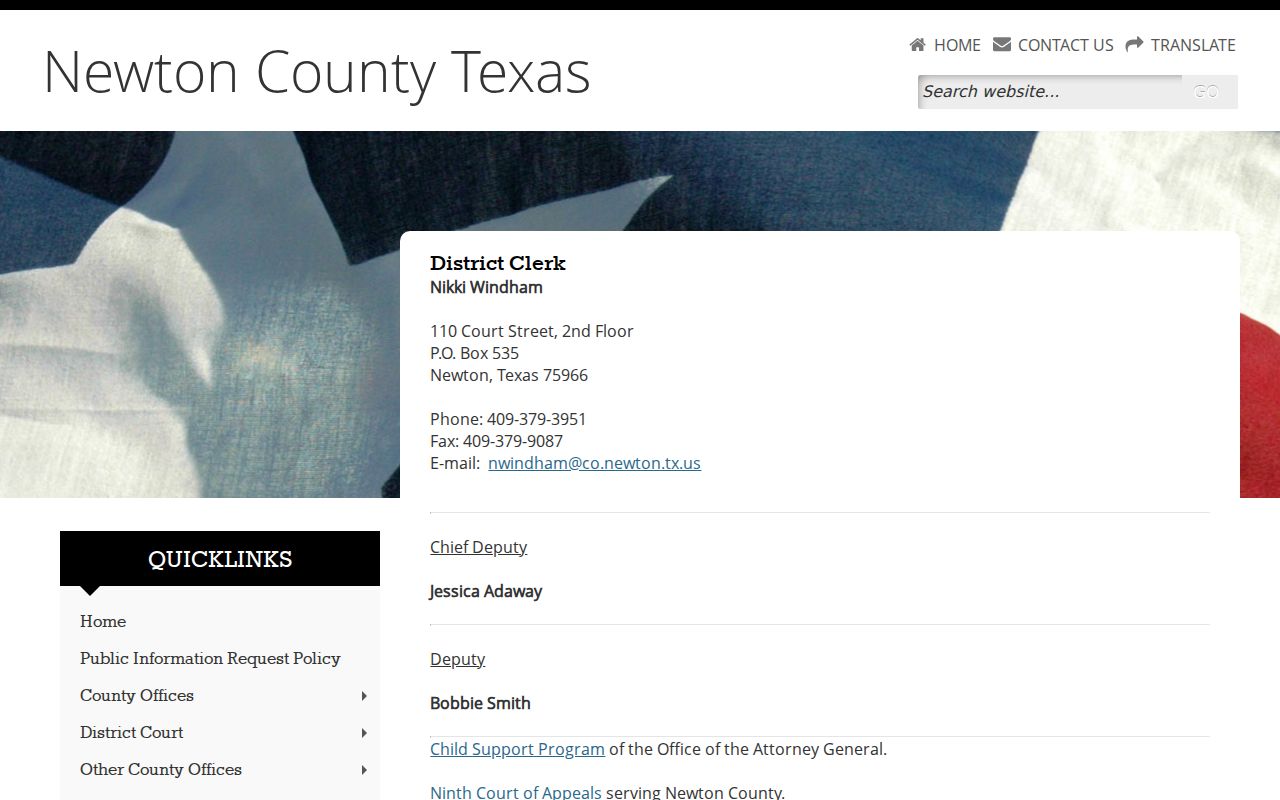
That official page explains the practical fallback. Phone, email, mail, or counter requests work when no public district result grid exists. Ask for exactly what you need. A plain docket sheet, a particular filing, and a certified judgment are three distinct products. A transcript is different still, and it must come from the court reporter.
What a Criminal Docket Shows
A Newton County criminal docket can identify the court. It also shows the case number, the filing or indictment date, the judge, the charge, counsel, status, and a dated chronology. It may also record bond activity, settings, motions, pleas, orders, disposition, sentence, or appeal. Newton County publishes no official sample docket. So don't guess at the case-number pattern or local display labels. Copy the number exactly as printed on a notice or court paper.
| Case number | The court’s identifier; the Newton County criminal format was not publicly verified. |
|---|---|
| Charge block | Offense, statute, and degree or classification when the system displays them. |
| Settings | Date, time, court, judge, setting type, and any reset or pass entry. |
| Case events | Indictment, motion, response, hearing, plea, trial, signed order, or appeal. |
| Disposition | Dismissal, acquittal, conviction, deferred adjudication, sentence, or another final action. |
Remember what a docket line is not. A charge is an allegation, not a result. A motion filed is not a motion granted, and a hearing setting is not a finding. When you need a result you can rely on, read the latest signed judgment or order and verify it with the clerk.
Newton County Criminal Dockets in 1-A
Newton County sits in the First Judicial District and the 1-A Judicial District. Published First District practice rules matter here. They say criminal cases may be filed and indictments returned to either district court in Jasper or Newton. The county name alone may not be enough. It may not reveal which numbered district court holds the active Newton County criminal docket. Check the court designation on the indictment, bond paper, notice, or a prior order instead. That is the safer guide.
The official 1-A Judicial District page names its judge and coordinator route. The page also shows the court's office details.
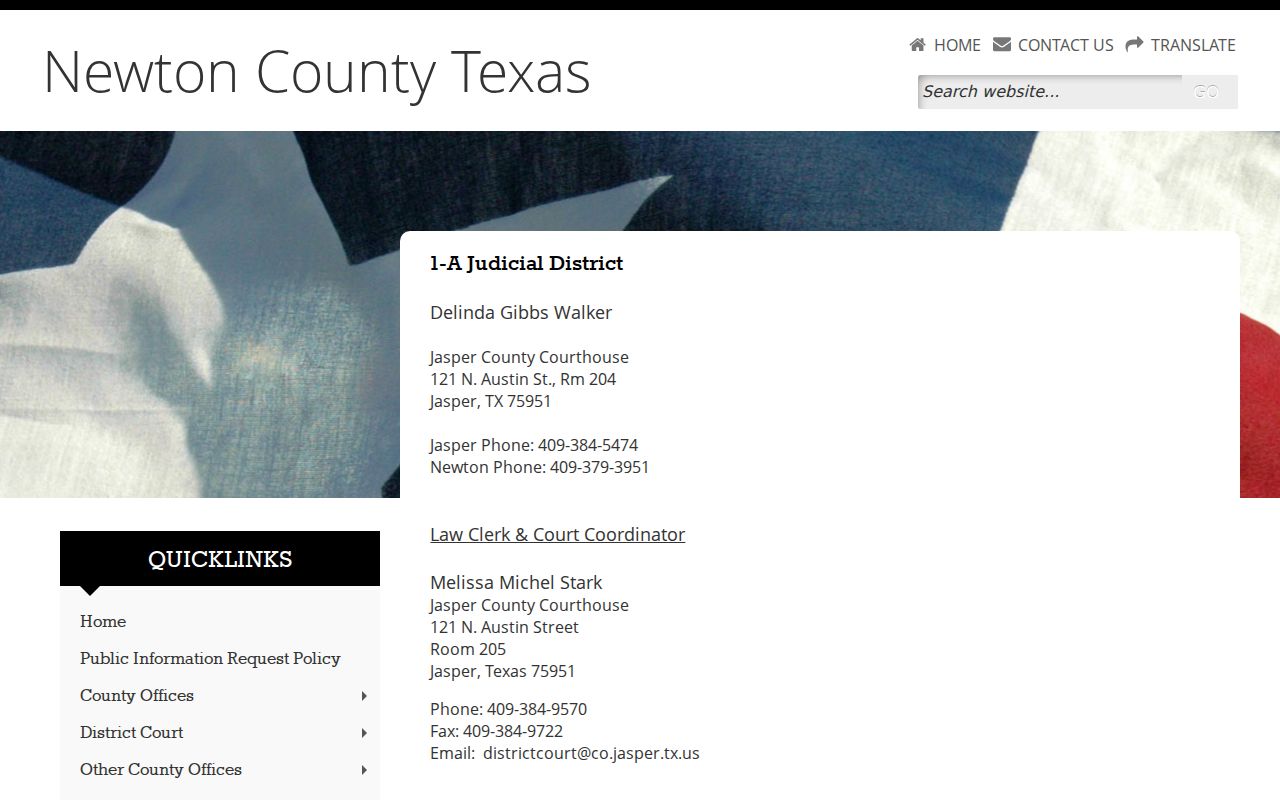
That page separates the court's coordination channel from the District Clerk's record-custody role. For a current district setting, contact the coordinator at 409-384-9570. For the docket sheet or judgment, go to the District Clerk.
Note: A coordinator can confirm a setting, while the clerk remains the source for the filed Newton County criminal record.
Stages on a Criminal Docket
Chronology drives a criminal docket. The formal record begins with a complaint, information, or indictment. Bond or magistration may follow. Some warrant and magistrate data sits in a separate justice record. Arraignment then records the plea and counsel status. Pretrial entries can show announcement, docket call, motions, responses, and hearing orders, before a plea or trial leads toward disposition and sentencing. After judgment, expect more entries. They include a notice of appeal, clerk's record, forfeiture, writ, or a related order.
Docket flow: Filing → Arraignment → Pretrial → Plea or Trial → Disposition → Sentencing
Start with the newest dated order for current status, then work backward through older entries. A reset moves the setting. It does not dismiss the Newton County criminal case. A plea entry and a sentence entry can also fall on different dates, so one line rarely tells the whole story.
Newton County Criminal Docket Routes
County-level criminal matters take a different path from felony dockets. The Newton County Constitutional County Court keeps its records with the County Clerk. Sandra K. Duckworth's office sits at 115 Court Street. It publishes 409-379-5341, fax 409-379-9049, and PO Box 484, Newton, TX 75966. Its TexasOnlineRecords link is account-gated. The public screen exposes no Newton criminal field list or result grid.
The official Newton County Court notice and contact page gives the court's own details.
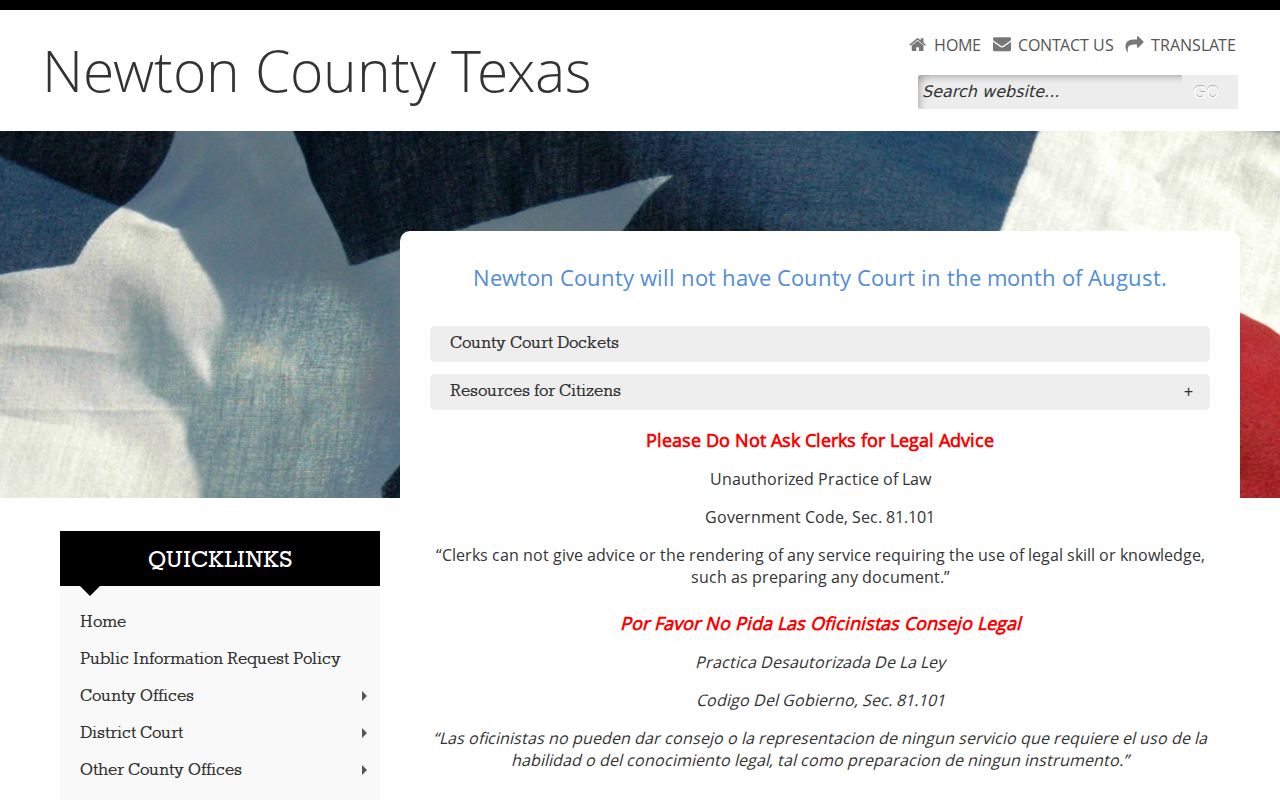
Newton County splits its criminal docket between two clerks, and that matters when a search comes up dry. A case missing from the District Clerk may simply belong to County Court instead, so treat an empty result as a routing question rather than proof the Newton County criminal docket has no such case. One more practical note: the County Clerk requires an appointment for public-record research because space is tight, so phone ahead before you go.
Which Court Holds Criminal Dockets
Where a Newton County criminal case lives depends on the charge and where it was filed. Felonies belong to the two district courts. The Constitutional County Court and the County Clerk hold county-level criminal records. Fine-only Class C and traffic cases may land in any of four JP courts, and municipal ordinance plus some fine-only state matters go to Newton Municipal Court. Not sure which? The citation, complaint, indictment, or notice should name the court.
| Court route | Typical criminal docket | Record contact |
|---|---|---|
| First or 1-A District Court | Felony and district criminal matters | Newton County District Clerk |
| Constitutional County Court | County-level criminal matters | Newton County Clerk |
| Justice Court precinct | Class C, traffic, and related JP matters | Named precinct office |
| Newton Municipal Court | City ordinance and fine-only matters | Municipal Court |
Each lower court runs its own office, so records live in separate places. A payment screen on a JP or municipal page is not the full Newton County criminal docket, even when it shows your name and a balance. If all you see online is an amount due and fields to pay, call the court and ask about its case record, the next setting, and how to get copies.
Newton County Criminal Docket Terms
Newton County publishes no official criminal code glossary. So treat entries like CONV, DEFER, DISM, NOLLE, ACQ, SENT, or NOA with care. Don't lock in a fixed local meaning without checking with the clerk. What controls is the full docket entry together with the signed order. Still, knowing the plain sense of these terms helps. It lets you ask the right question when you call.
- Disposition
- The recorded outcome or closing action, which should be checked against the judgment.
- Deferred adjudication
- A court-ordered result that is not the same as a standard conviction entry.
- Nolle prosequi
- A prosecution decision not to proceed with a charge, subject to the actual record.
- Reset
- A move from one hearing date to another, not a dismissal.
- Notice of appeal
- A filing that starts appellate review; it is not the appellate decision.
Bond and warrant entries are not a disposition either. A docket line there may record release terms, a capias, a forfeiture, or magistrate action while the criminal charge itself stays pending.
Missing Newton County Criminal Dockets
A blank result online is rarely the last word. Strip away any broad filters first. Search again with an exact name or a known case number. Then confirm the matter truly belongs to Newton County. Check which court the papers name, whether that is a district court, County Court, JP precinct, or municipal court. Call that office next. The clerk can explain whether the case sits under a different court's index. The record may be too new to post, or access may be restricted. District records go through the published email, fax, mail, phone, or the second-floor counter. For County Court records, use the County Clerk's phone, fax, mail, or appointment-based research process. Class C cases stay with the named JP or municipal court. Work down this chain. It beats treating re:SearchTX as a complete archive of the Newton County criminal docket.
Public Access and Sealed Criminal Dockets
Public access has limits online. Sealed records, sensitive data, and juvenile records can be restricted or redacted. Texas Rule of Judicial Administration 12 governs judicial records. Court case records also answer to the rules, orders, and statutes controlling the clerk's file. Don't assume the Texas Public Information Act forces every adjudicative court record onto a website. It is not a blanket online-access rule.
Key Rules:
Texas Rule of Judicial Administration 12 generally opens covered judicial records but permits legal restrictions and sets a written-request process.
Texas Family Code Chapter 58 restricts access to juvenile records and provides sealing rules.
Texas Rule of Civil Procedure 21c requires sensitive data to be redacted from filed documents.
The official juvenile statute source is also preserved in the capture below.
Juvenile cases call for different expectations. OCA records show the District Clerk handles district juvenile work, while the County Clerk's own verification lists County Court juvenile as absent. Never publish a juvenile's name, and never read a missing search result as proof that no case exists.
Request Newton County Criminal Dockets
A written request works best when it names the court, gives the exact case number or style if you have it, describes the record you want, offers an approximate date, and says whether you need a plain or certified copy. Include contact details and ask for a fee estimate. Skip needless personal identifiers. Before mailing any funds or sensitive material, confirm how that office accepts delivery and payment. No case number? Give the exact name and a narrow date range instead. Ask whether you can inspect the file at the counter or through another office-approved method. Restricted, sealed, or juvenile material may demand proof of authority or a court order, and if access is denied you can request the rule or order relied upon. The broader Newton County case search can help you spot an index entry, but the originating clerk is still the source for an authenticated criminal judgment.
Note: District and County Clerk fee statutes exist, but Newton County’s current payment method and turnaround were not published.